Notes on a Notebook
Posted on 23 September 2026
As a bookbinder, I am sometimes asked to make blank books. It could be a simple notebook or a journal to be used for years and even passed on to future family members. Creating a blank book like that in a historic style can be a challenge too - old books are often stiff tightbacks, so how can you make a book like that a nice experience to write in?
Well, interestingly, in my collection is a blank notebook from over 250 years ago.
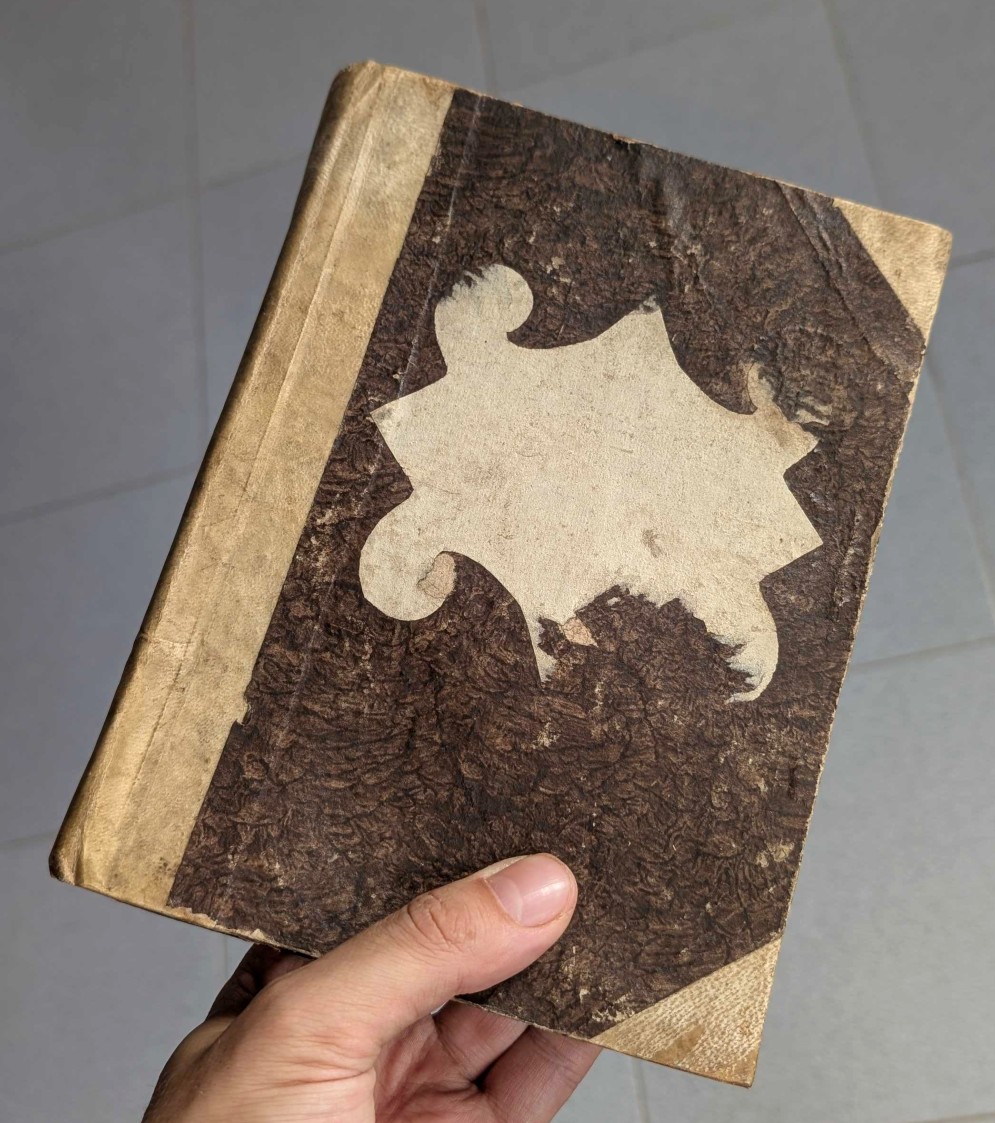
Front cover and cover label
I bought it on eBay about six years ago, with no history given by the seller. It's a blank book with only a date of 1769 and two initials in irongall ink on the front pastedown. There's an ornately cut paper name label on the front cover, still blank after over two centuries, and about 220 leaves remain inside - unfortunately the first and last gatherings have been torn out.
So hopefully a bit of a deep dive into how it was bound and what materials were used might help us today when we consider how to bind a sketchbook or journal in a structure and style that is faithful to historic bookbinding.
When and where is it from?
The date of 1769 is extremely helpful in giving the notebook binding an approximate age, and the fact that a few gatherings are torn out show that it was used a bit when it was new since it was presumably the first owner who wrote in it, and the binding style can't be much earlier than mid-18th century.
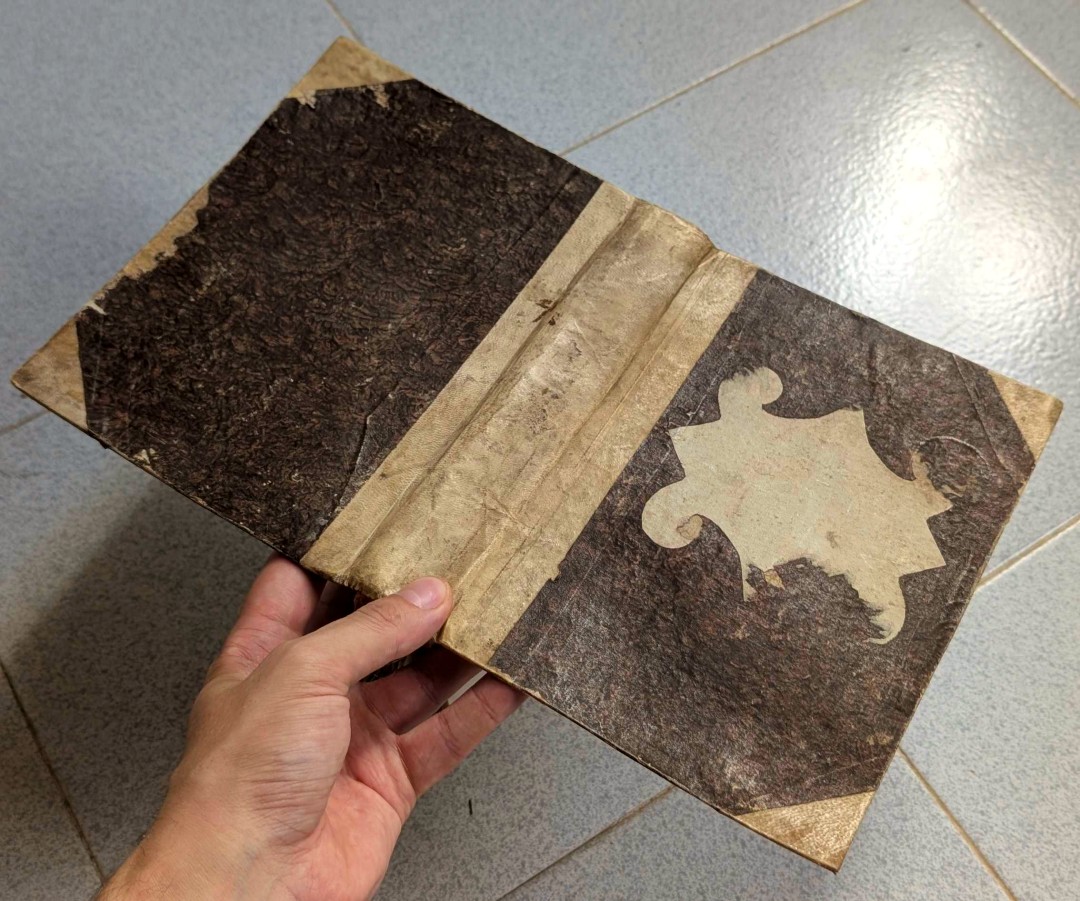
The entire cover of the book
I had always assumed it was a German binding, since it is extremely similar (especially the ornate paper label on the front cover) to late 18th and 19th century German notebook bindings that I've seen before. It's half bound in vellum with decorative paste papers on the cover.
The paper, however, is not from anywhere near Germany! The watermark on the paper is a bird over the top of IHS, and below this there is "Frco Ri" and "Capellades". This watermark means the paper was manufactured at a mill in northern Spain owned by Francesc Romaní i Soteras, who was making paper with that watermark from the mid to late 18th century.
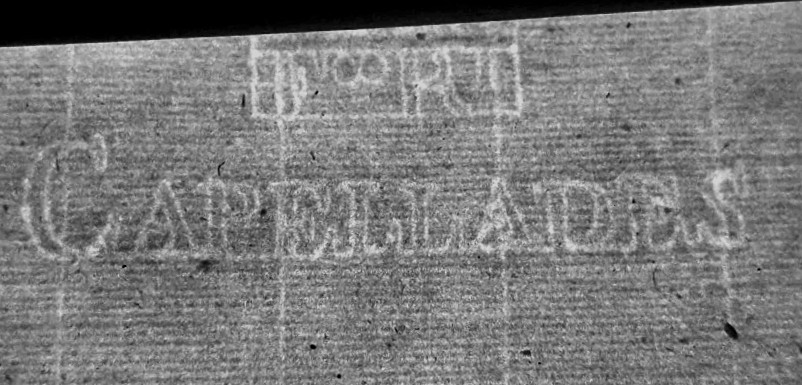
Watermark
That region at the time had a booming industry in papermaking, and it's not uncommon to find this paper used in books across Europe and even in South America.
This all ties into it being a binding produced not long before the handwritten date of 1769.
The sewing and structure
The book is made of gatherings of five sheets folded into ten leaves on two sawn-in cords reinforced with strips of paper. It is rounded and backed, with speckled edges. There's a hollow at the spine between the rounded textblock and the vellum spine, and there is no evidence it ever had endbands. The textblock has certainly been well beaten before binding.
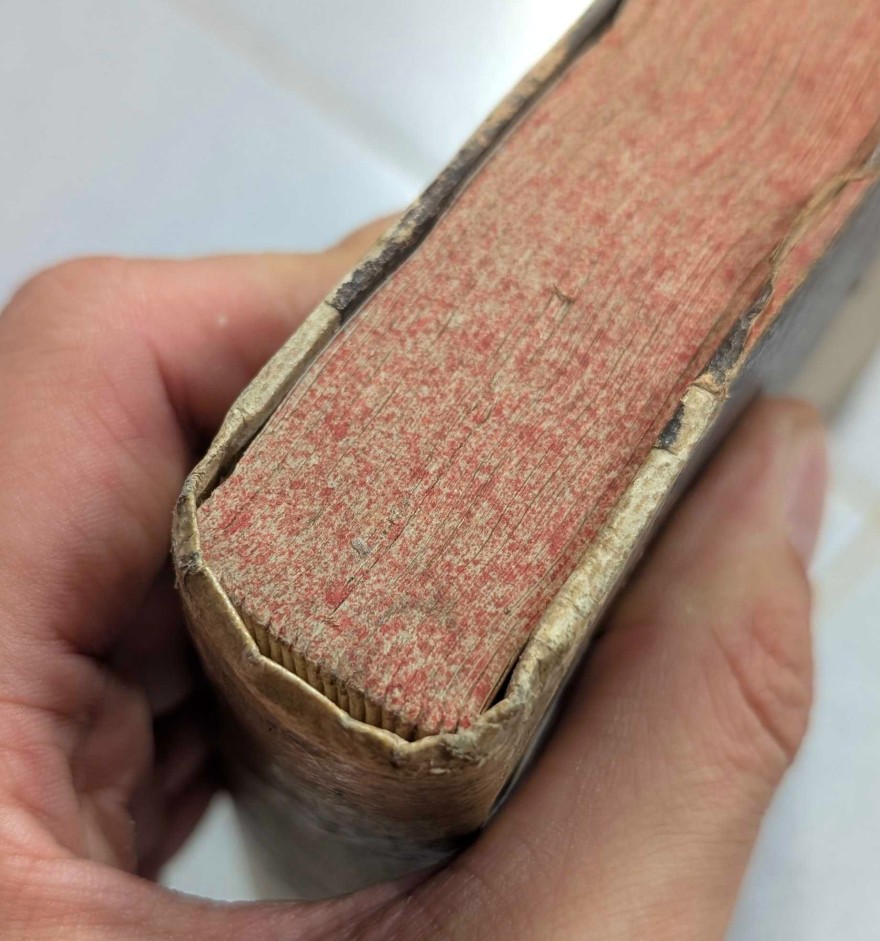
Top of the spine and top edge
Unusually, the linen thread used to sew it is not a white-ish thread like you normally find in books, it is instead dark brown.
The boards
So far we have an apparently German style binding using Spanish paper, but there are a few further unusual styles in the way the boards and endpapers are attached. The boards are cross mounted, which is typical of French bindings of the 18th century. The boards are extremely thin, only about 1mm, and apparently made from old recycled boards: There's red colouring visible along one edge where the covering paper has worn away, while the book itself has speckled edges rather than solid red painted edges, and along one foredge side some old vellum is visible underneath an area of damaged decorative paper.
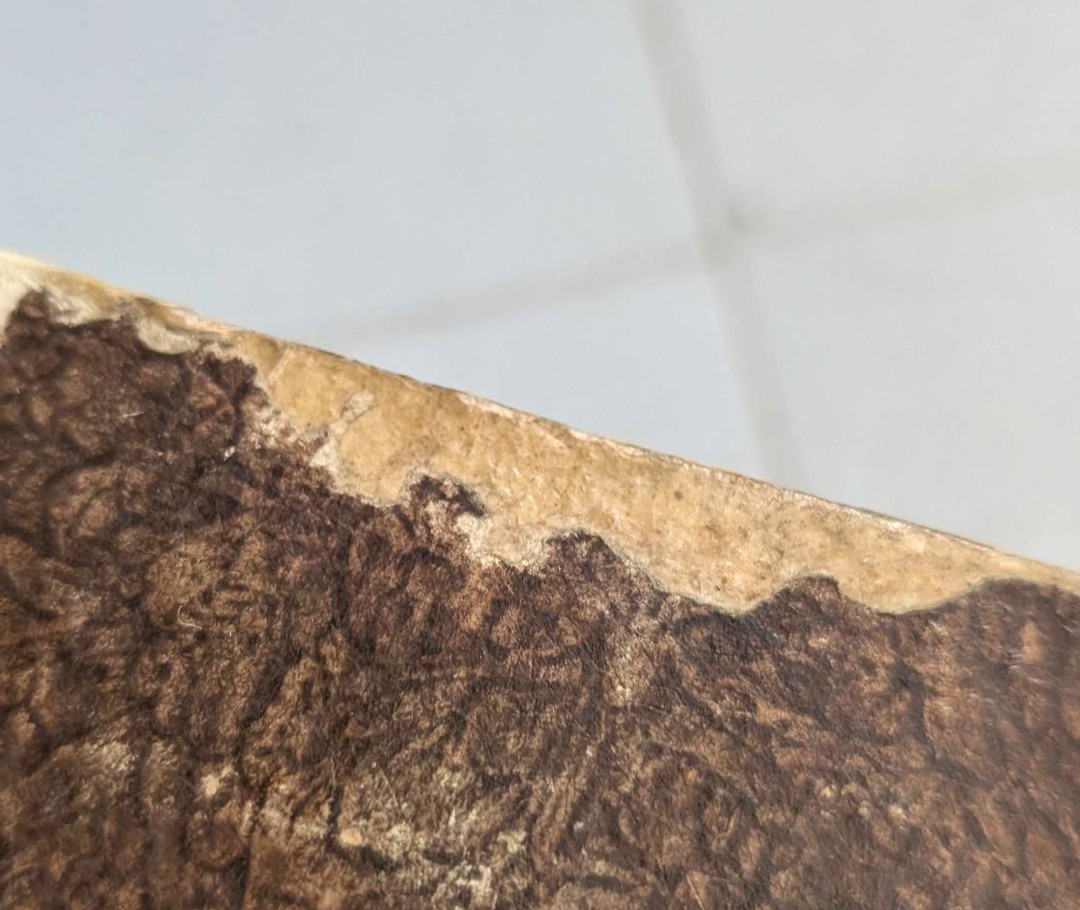
Vellum covering on recycled boards showing under decorative papers
On the whole it's not that surprising - this was presumably a cheap notebook so recycled materials make sense. (and there's more to come)
Under the pastedowns, the waste sheets have been cut into triangles and glued down. I've seen this specific treatment on both English and French bindings of the 18th century.
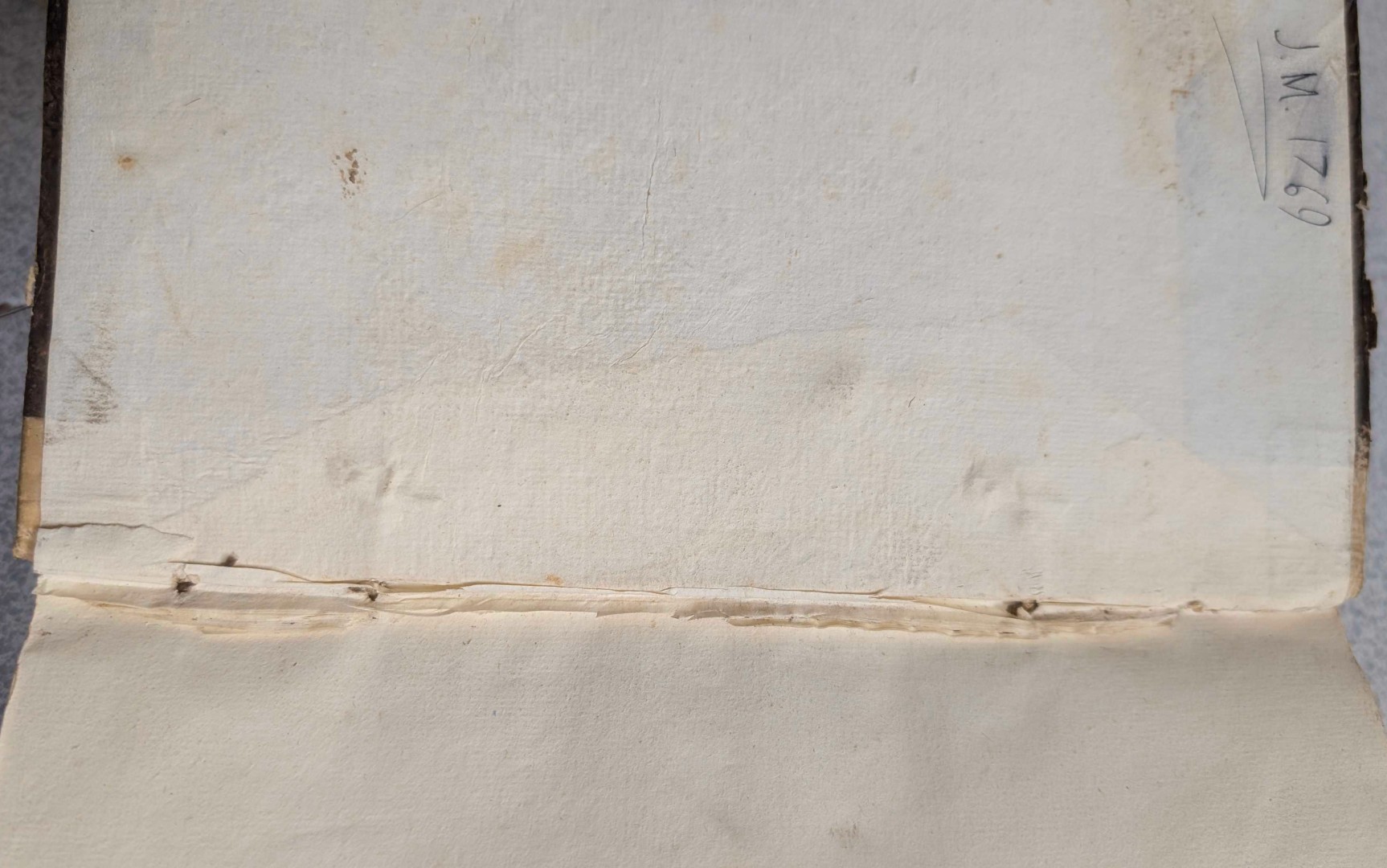
Pastedown, showing cross mounted boards and triangular (ish) waste sheet under pastedown
The covering materials
The paste paper used is a fairly standard looking paste paper. The vellum spine and corners show signs of also being recycled - there's no evidence of writing on them, like manuscript waste often found in old bindings, but there is an old fold in the vellum which has nothing to do with how it was used in the binding, so it's possibly a gutter or margin of an old vellum book or document that was good enough to use for outer covering material here.
A conclusion?
It is very interesting looking at an old binding this closely and seeing how international the world was even almost three centuries ago. This is a probably German binding with French influence in the binding practices, and made with Spanish paper as well as bits of other recycled books.
Structurally it has held together very well and even now it does open easily and could still be used as a notebook - the vellum spine has held up much better than leather would on a hollow (not that leather spines with hollows were a thing in the mid-18th century), and that allows the book to open nicely at any point in the textblock. The sewing and the cords have held together better than many 18th century books, perhaps the dark brown linen thread has survived so well because it was not bleached and therefore not exposed to any chemical process that could weaken it. Arguably though, the sewing might be in such good condition because, unlike other books that might have been read many times over the centuries, this book does not appear to have been used after its first owner.