A Brief Study on the Practices of John Wright, Bookbinder
Posted on 9 June 2026
I have recently acquired a box of books printed at the start of the 19th century. Most of them are pretty average books, except for six folio volumes of the same set - when they arrived there was an extraordinary surprise that I hadn't expected and the auction house hadn't noticed either - all but one were in very fine bindings signed "Bound by J. Wright".
This "J. Wright" was John Wright, a highly respected early Victorian bookbinder working in Soho during the second quarter of the 19th century. During his lifetime, he was considered one of the finest binders in London. His workshop operated from Noel Street and, by the 1850s, had grown into a substantial business spread across three buildings. These particular bindings date from the mid 1840s when the set was published.
Wright's workshop produced elaborate and technically skilled bindings, including richly decorated leather bindings that were beyond the skill of most bookbinders of the time. Tragically, his life as well as five others in his workshop were cut short by a cholera outbreak in the late summer of 1854. This was the same outbreak that famously led John Snow to discover the cause of cholera and take the handle off of the water pump that was the cause of it - and led to the naming of the pub there The John Snow, where I used to go for drinks when I was working in London.
Using the books that I have recently acquired, here is a short summary of the processes I can see used by Wright's workshop, and what differs technically and structurally from the one other volume from the same set I have that is in a standard binding (a vellum half binding) of the same period by another less accomplished bindery.
The sewing
The sewing structure of the non-Wright binding is a straightforward Victorian binding done as cheaply as possible. It is on three sawn-in cords with a kettle stitch about 2cm from the head and another about 3cm from the tail. It is sewn two-on and certainly never had endbands. The sewing has completely failed and it is a mix of loose and partly-loose gatherings.
The Wright bindings are also on sawn in cords. There are four matching bindings and one different, slightly finer binding. All are bound on five sawn in cords and the kettle stitches are only about 1cm from the head and tail. The sewing has mostly survived well, with one gathering loose in the largest volume.
The boards and board attachment
With the Wright bindings, the cords are laced into the boards, they are frayed out and glued down on the inside. Almost all of the hinges have failed with the boards now being detached, due to the boards being very heavy and the cords being relatively thin. A triangular notch about 25mm long on the spine side and 5mm long on the head and tail side has been cut at the head and tail of the board where it meets the textblock, to allow the covering material to be brought around the head and tail of the book neatly.
The boards are a mix of thicknesses. All are traditional pulp board. For four of the five Wright bindings they are about 4mm thick, likely professionally made rather than made from scraps in the bindery as there are no obvious inclusions of odd materials that can get mixed into the pulp if the pulp is made up by the binders themselves in a busy workshop. The fifth, finer Wright binding has exceptionally thick boards - being about 8mm thick.
The boards on the non-Wright binding are slightly thinner than any of the Wright bindings, around 3mm.
The endpapers
The endpapers in the Wright bindings are laid paper, the same as the text. They're marbled in a traditional red, white, blue, and yellow colour palette combed and with swirls, a style often referred to as "old dutch". The area on the inside the board has not been in-filled with a sheet of paper before the pastedowns were put in, so the turn-ins create a slightly raised area under the edges of the pastedowns.
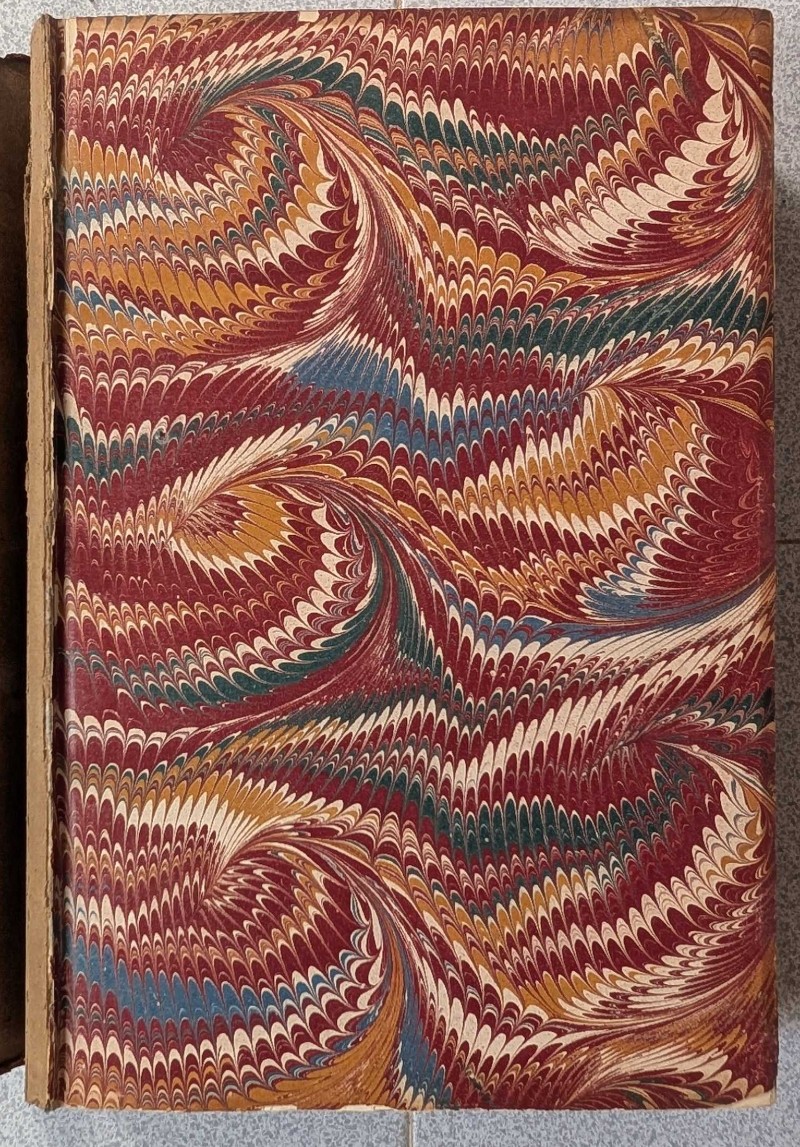
The endpapers used in the Wright bindings
The structure of the endpapers seems to be tipped on endpapers, like this structure. Like in Figure 14 on that page, there is a single white flyleaf tipped in before the textblock.
Beating
There is evidence of both the non-Wright binding and the Wright bindings having been beaten before binding to compress the textblock.
The endbands
Between all five Wright bindings, only two endbands survive. They are extremely fine endbands with a tall, rectangular profile, sewn around a hard leather core, and they are sewn using three colours to match the red, white, and blue of the "old dutch" style marbled endpapers.
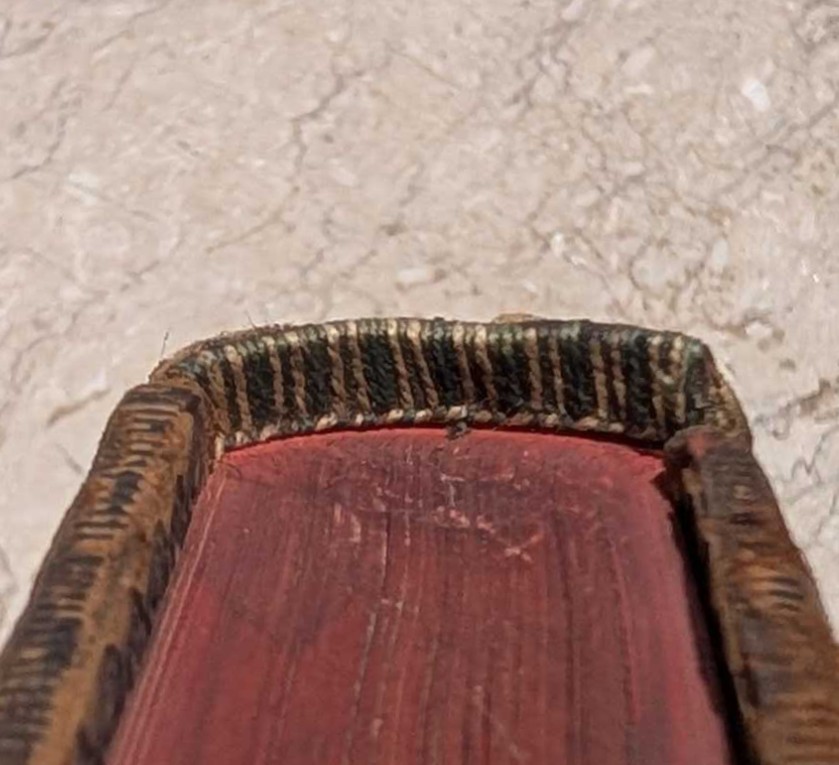
The endbands on the Wright bindings
The reason for all the other endbands being missing is immediately obvious when you look at the head and tail of the book - they're only tied down in three places; at either end of the textblock and once approximately in the middle, similar to French bindings of the 18th century. It is impressive that the surviving endbands are so perfectly sewn when you consider how much it must have wanted to move around during the sewing process. Presumably it was constantly pinned down as it was being worked.
The rounding and backing
The Wright books are all rounded and backed very well, as you would expect in any fine Victorian binding, with shoulders of 4mm. They are glued up with rabbit hide glue and heavily lined with blank brown paper, which was also used to create a hollow.
The rounded and backed textblock of one of the Wright bindings
There are five fake bands on each book created with small strips of leather turned flesh side out underneath the covering material.
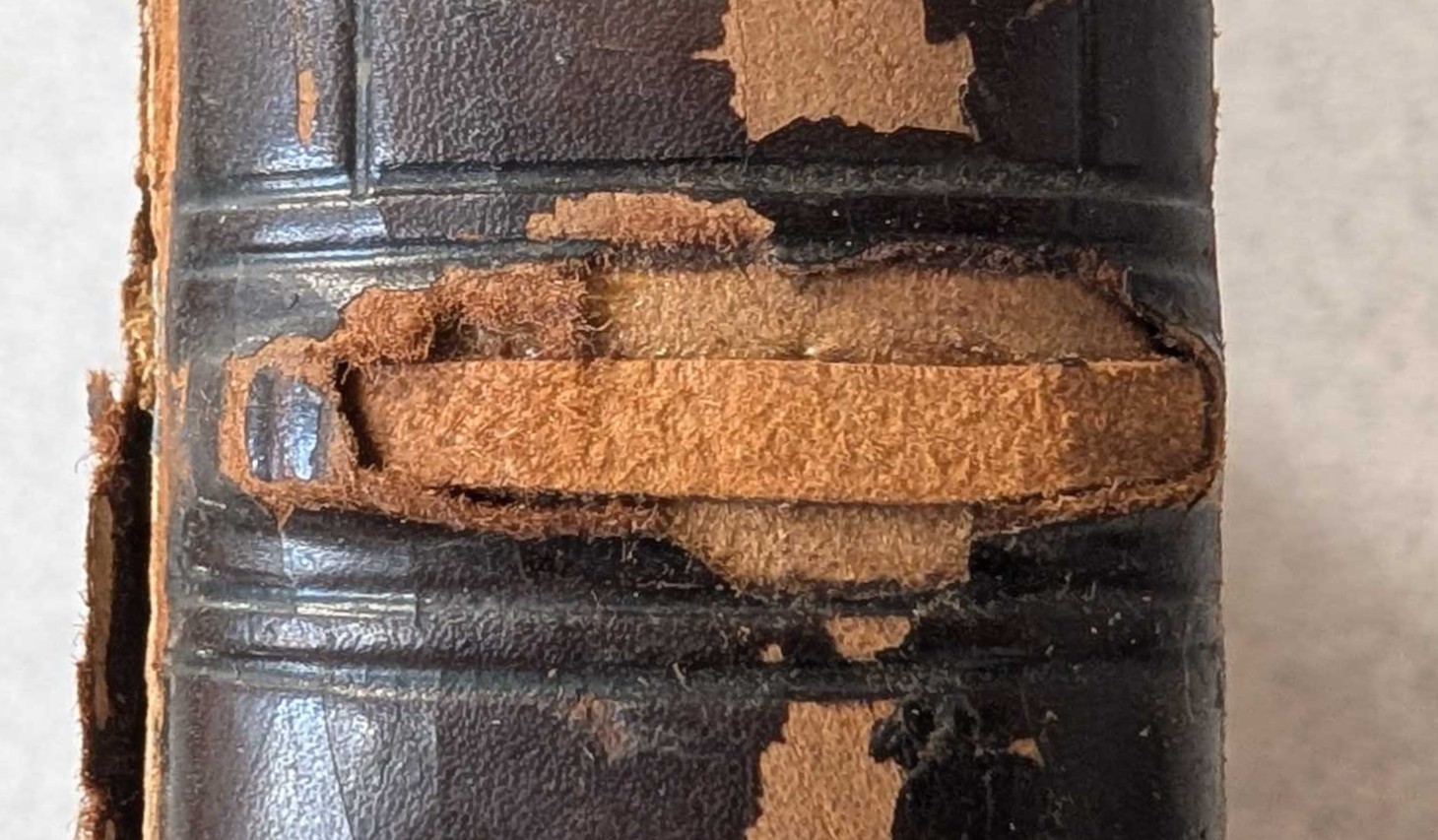
One of the fake bands exposed on a damaged Wright binding
For the non-Wright bound copy, that has also been rounded and backed, but quite poorly. The gatherings especially towards the head end of the spine are crushed heavily in one direction rather than being evenly backed.
The fore edges
The non-Wright binding comes almost certainly as the publisher supplied it - the fore edges are roughly trimmed with a plough enough to make the book look square, but there are plenty of deckled edges surviving. Going by a few pages that had corners or edges folded over before it was trimmed, this book was trimmed by ~2mm on each edge. This book must have been trimmed on the day that every right-angle in the bindery was missing, because even though the textblock looks square, close examination shows that the top and bottom edges are cut quite a few degrees off of square.
The Wright bindings have been trimmed more than the non-Wright binding, with each edge being trimmed by about 7mm, but they are perfectly square. The edge finishing is where the Wright bindings I have differ between each other. On four of the volumes, the edges are finished with a red pigment and burnished to a bright shine.
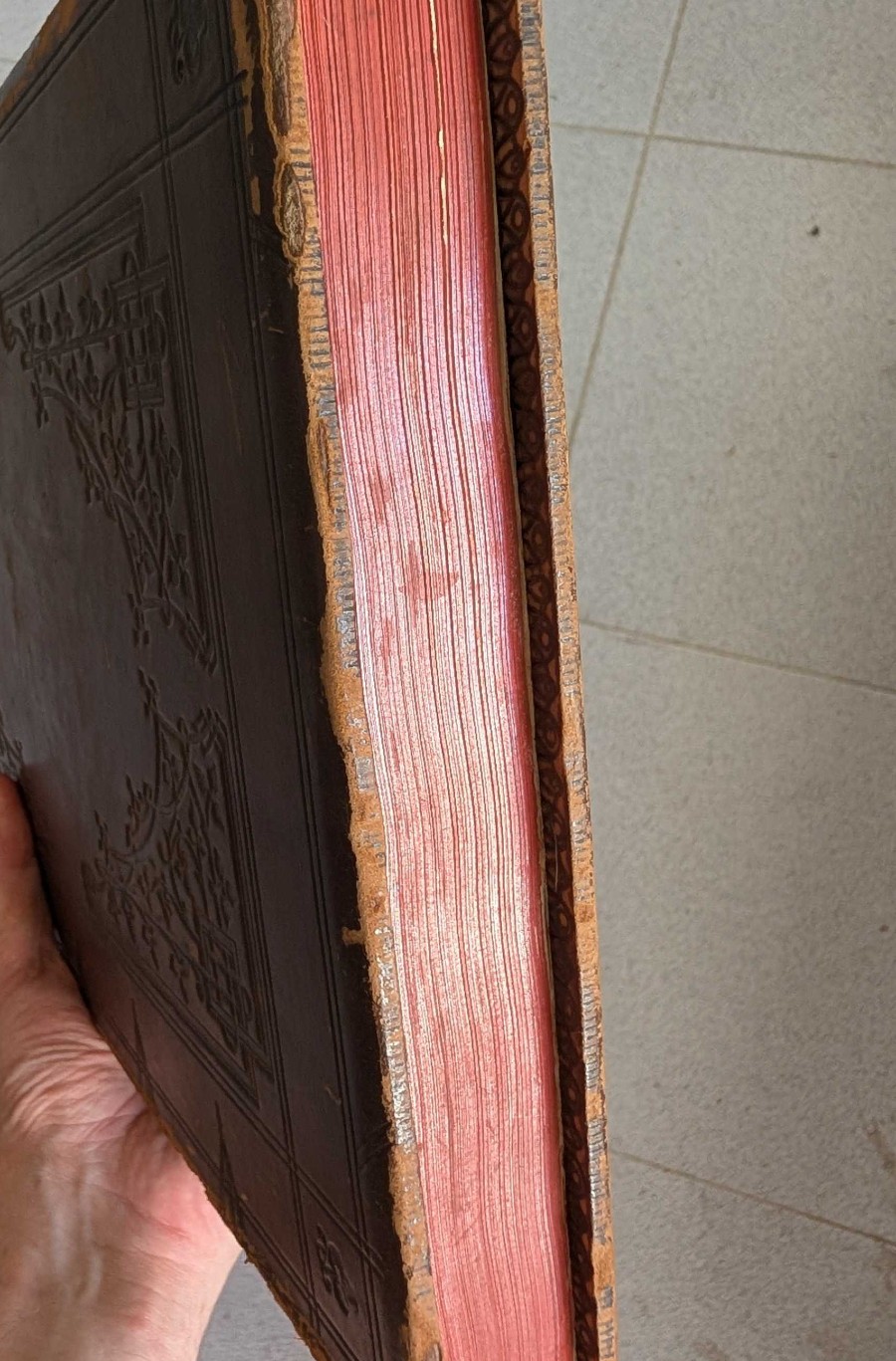
Red fore edge on one of the Wright bindings
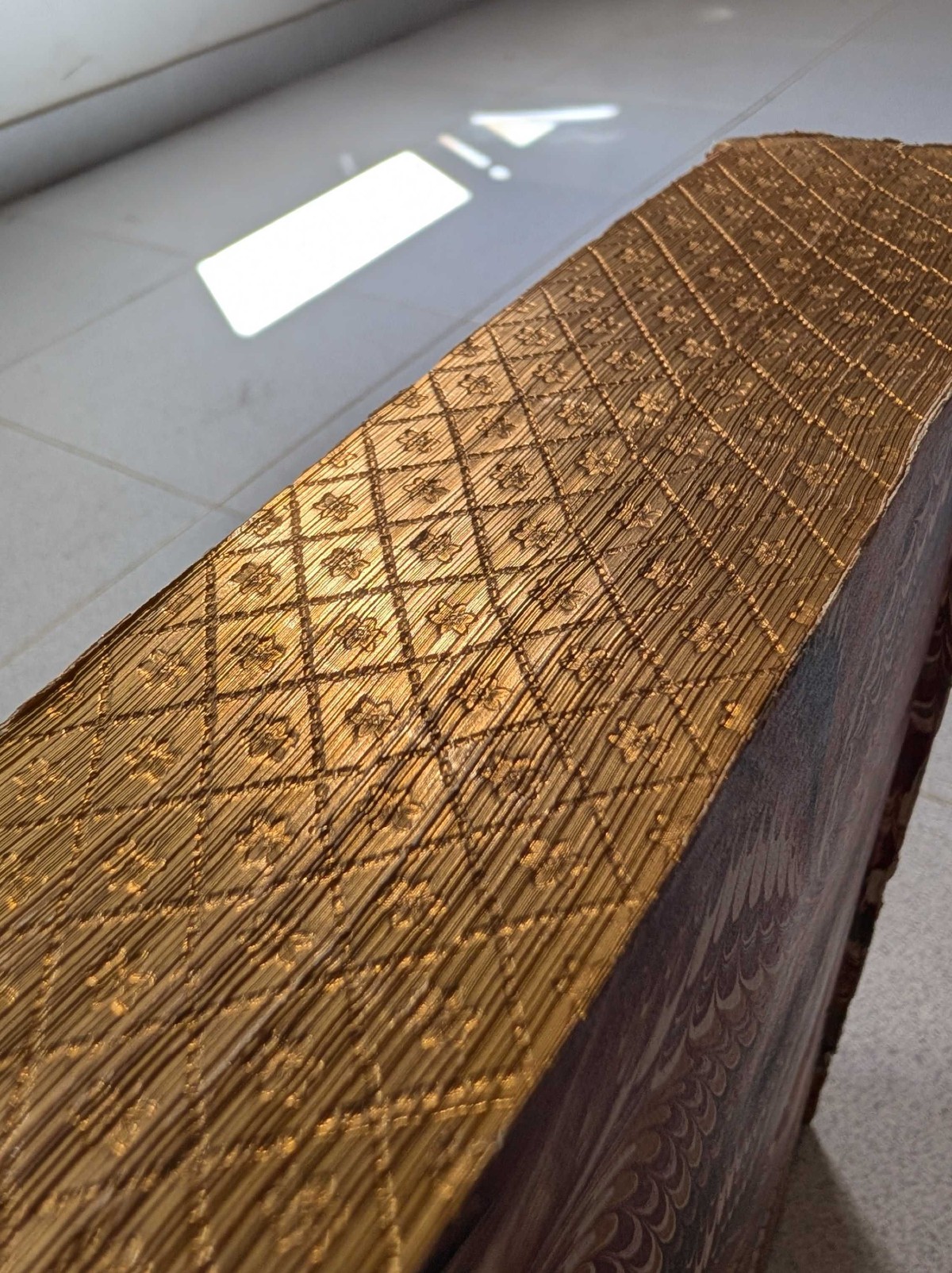
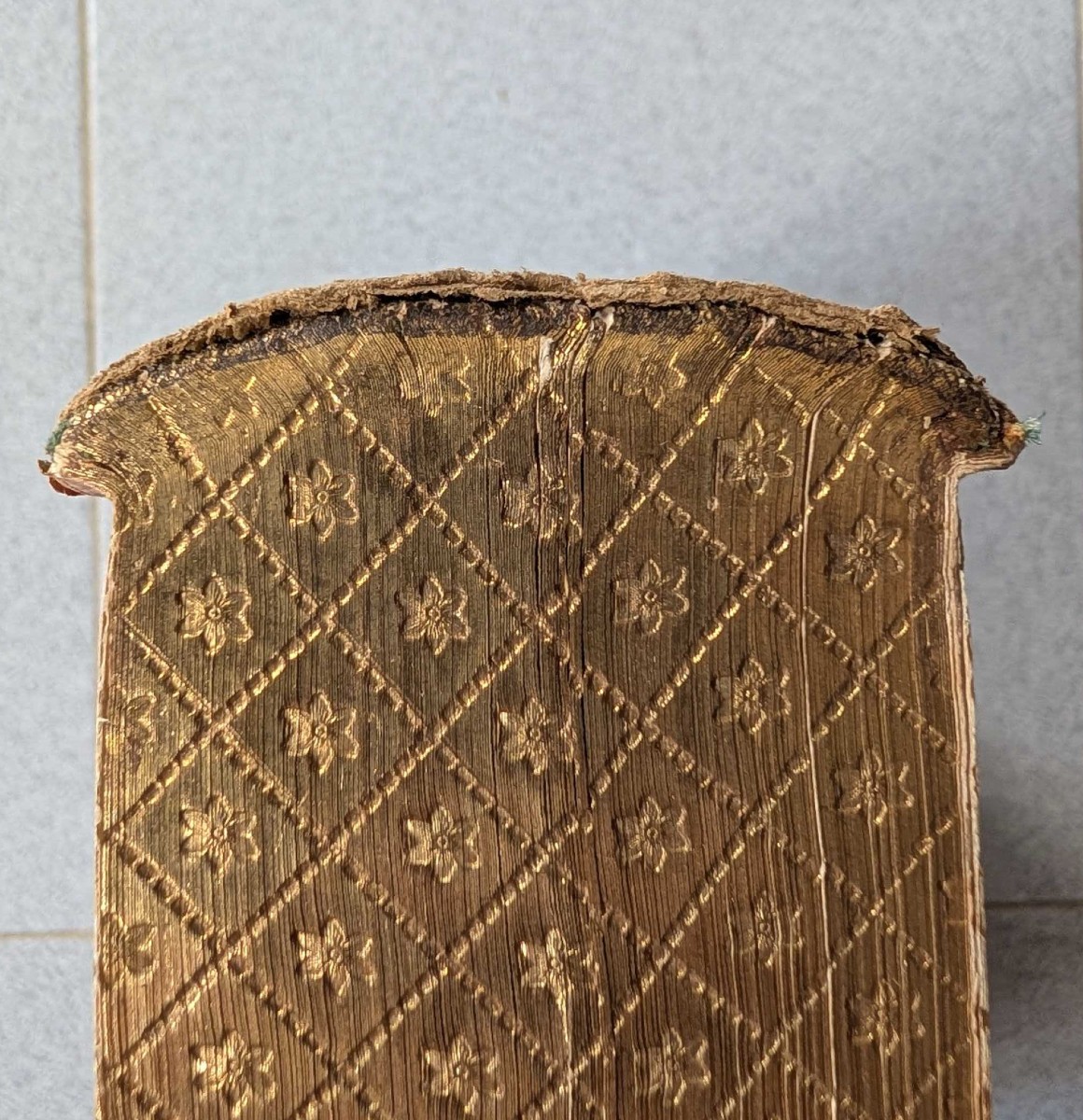
The other Wright binding has been taken further - the edges are gilt and gauffered in a hatched pattern using a dot pallet with a flower tool inside each crosshatch. It is possible these were rough edge gilt rather than solid edge gilt, due to the edge not being completely flat and each gathering sitting in a slightly different position, but it is more likely that it was originally solid edge gilt and the sewing has become slightly loose over the last 200 years. This same effect can be seen on the red painted fore edge above.
Gauffered fore edge on one of the Wright bindings
The covering material
All of the Wright bindings are bound in leather pared very thin and evenly all over, as you would expect for a fine binding of the period. The matching bindings are in a highly polished calf and the slightly finer volume in a heavily grained morocco that is not polished, this second material is very similar to the heavily grained leather you find on Victorian photo albums and the like.
The tooling
Interestingly, all the Wright bindings are bound in more or less the same design, and this may have been done in partnership with the publisher as part of a number of finely bound copies of the same edition. I suspect this was the case because the provenance of the four matching volumes vs the one finer volume is completely different, so it must have been the binder who had knowledge of how the other volume was bound and re-used the same design, rather than the original owners of the books.
The decoration of the boards is done in blind using very large stamps, almost certainly done on a blocking press as the stamps are put in very evenly. This would make sense if there were a number of these volumes to bind in a similar style as it would be much less labour to put each book into the blocking press and stamp on the design in one go. Some extra work was done by hand after this to add in details near the bands and around the edge of the boards.
The titles are tooled directly onto the spine rather than onto a separate piece of leather as a spine label. They are titled with handle letters, but so evenly that it is only by a couple of letters being slightly out that you can tell it was not done with brass type and a type setter. The gilding of the letters on the matching volumes is somewhat crude and the gilding itself is uneven, but on the finer volume it is perfect.
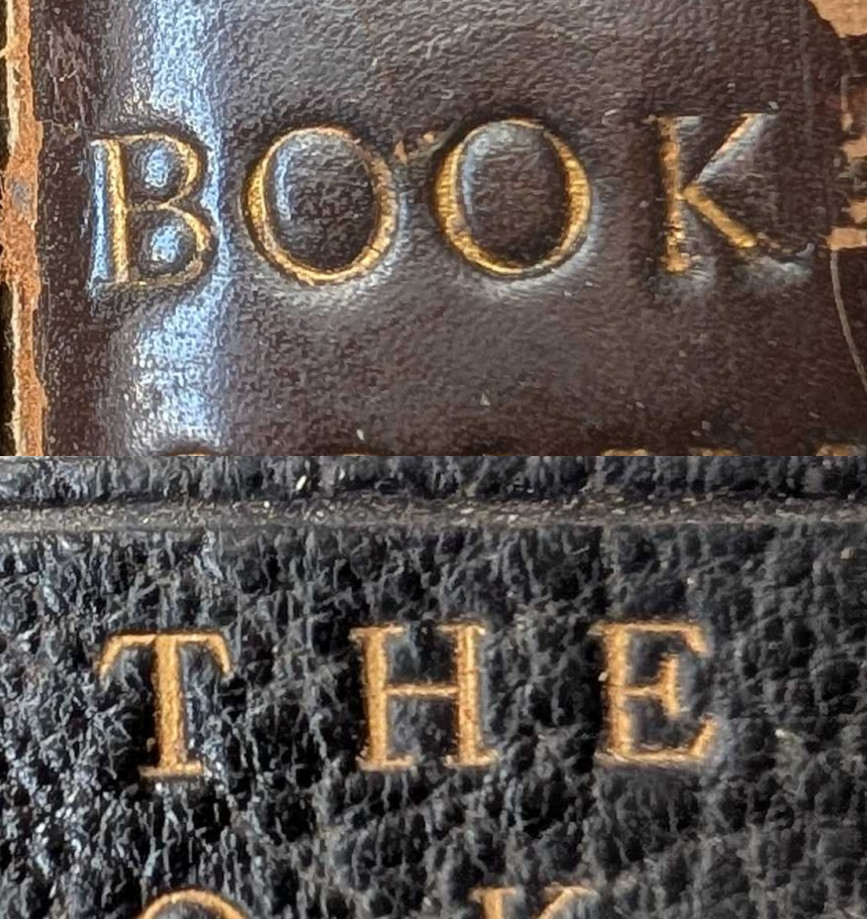
The two version of gold tooling, with the top one being poorer quality and the bottom one being much cleaner.
From a slight variance in the depth of the impression from the top to bottom of the letters, the finer volume was certainly tooled with the letter tools being pressed from the bottom edge first and rocked upwards to create the impression. The lack of slanting of any of the letters and angle of the impression likely means that the book was put in the finishing press and the bookbinder stood at the tail end of the book and tooled the title looking up the spine.
Looking at other examples of Wright bindings online, the poor quality of gold tooling on the matching volumes is unusual for Wright bindings, and is likely down to an apprentice or someone less experienced in the bindery having done this work.
The signature
All of my John Wright bindings are stamped "Bound by J. Wright" in black ink to the back of the front free endpaper. Looking at examples of other Wright bindings online, he more commonly stamped his bindings at the bottom of the front pastedown, but with the endpapers in these books being marbled it would not have been possible.
There were two other variants of his binding signature stamp, which does not appear in these books, one that read "J. Wright Binder" and another that just read "J. Wright"- these appear in books published both before and after the books that I have (as well as the "J. Wright" stamp in another book currently on Abe books), so it seems like he used these stamps interchangeably.